

497
Shares
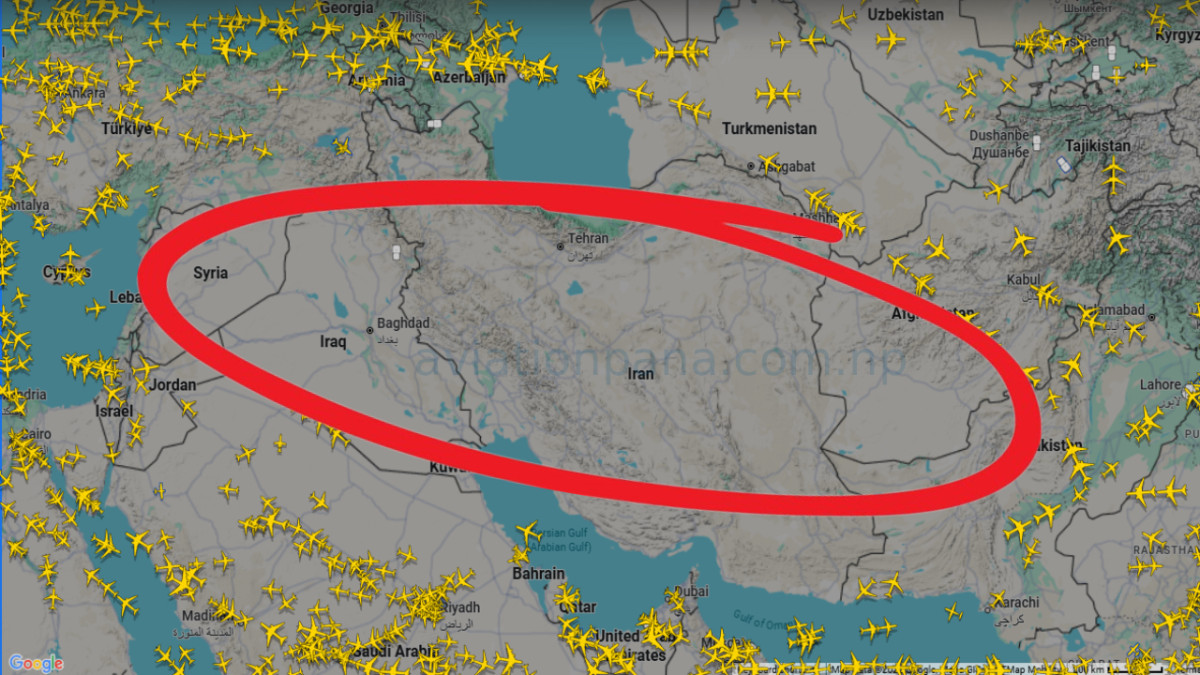



KATHMANDU,NEPAL: Pull up Flightradar24 right now. Where you'd normally see hundreds of aircraft threading through the Middle East, one of the busiest air corridors on the planet, there's almost nothing. Just empty sky.
Pilots have started calling it the hole in the sky. And it's the worst thing to happen to global aviation since the pandemic.
On February 28, the United States and Israel struck Iranian military targets. Iran hit back. Within hours, eight countries had slammed their airspace shut: Iran, Israel, Iraq, Jordan, Qatar, Bahrain, Kuwait and the UAE.
Airlines didn't get a warning. They got a NOTAM.
Over 21,300 flights were cancelled across Dubai, Doha, Abu Dhabi and four other major airports in the opening days alone. Emirates went quiet. Qatar Airways cut its schedule to a fraction of normal. Etihad was operating at roughly 15% capacity. Three of the world's most powerful airlines, carriers that between them move more than half of all passengers between Europe and the Asia-Pacific, had effectively stopped flying.
Iran, Iraq, Bahrain and Kuwait are still closed. The UAE has cracked open slightly, but only through a single restricted western routing. EASA has put out a Conflict Zone bulletin telling every operator in plain terms: don't fly here, at any altitude, over Iran, Iraq, Israel, Jordan, Lebanon, Bahrain, Kuwait, Qatar, the UAE, Oman or Saudi Arabia.
So where do you go instead?
North, through the Caucasus, which takes you uncomfortably close to Russian airspace. Or south, looping through Egypt and down the Saudi coast, adding two to three hours to flights that were already long. Neither option is cheap. Neither is ideal. But right now, they're what airlines have.
Every extra hour in the air on a wide-body costs an airline somewhere between $6,000 and $7,500. Multiply that by hundreds of daily long-haul flights and the losses stack up fast. Jet fuel prices have roughly doubled since early March, sitting around $160 a barrel. Brent crude hit $119 on March 9, levels last seen when Russia invaded Ukraine.
Airlines that were smart enough to hedge their fuel are surviving better. Ryanair, for instance, locked in 80% of its fuel needs through March 2027. Most weren't that lucky.
One aviation analyst described the situation simply: "Pretty well the biggest shutdown we've seen since COVID." It's hard to argue with that.
Here's the thing about Nepal's place in global aviation. Almost every international connection runs through the Gulf.
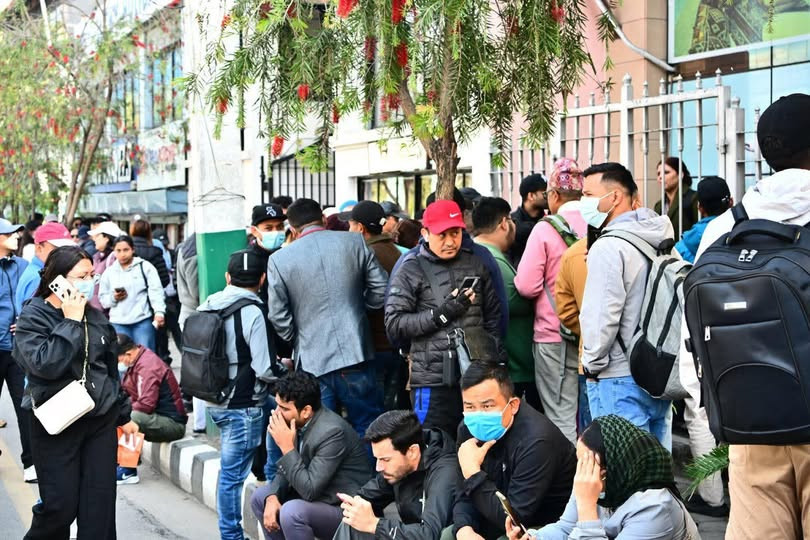
Dubai, Doha, Abu Dhabi. Those three cities are the gateway for most Nepali passengers heading to Europe, the Americas and Africa. They're also where hundreds of thousands of Nepali migrant workers transit on their way to jobs across the region. When those hubs go dark, Nepal doesn't just feel it. Nepal gets cut off.
Cargo is disrupted. Ticket prices are climbing. Workers can't get home. Families are separated.
There's a bigger lesson here too, one that aviation planners in Kathmandu would do well to sit with. For years, Nepal's international connectivity strategy has essentially been: fly to the Gulf, connect from there. This crisis exposes exactly how fragile that dependency is. Direct routes to Bangkok, Kuala Lumpur, strengthening the Kathmandu-Delhi corridor, these aren't just nice ideas anymore. They're insurance.
Nobody knows. That's the honest answer.
Qatar has partially reopened, with some cargo and evacuation flights moving again. Emirates is slowly rebuilding, operating around 60% of its pre-war capacity as select corridors reopen. But a full return to normal requires a ceasefire, diplomatic agreement, and a gradual restoration of confidence. None of which happen overnight.
What's particularly tricky for airlines is the middle scenario. A complete closure is bad, but at least everyone knows where they stand. A partial reopening, some routes available, others not, conditions changing daily, is operationally chaotic. You can't plan schedules, price tickets or crew flights on uncertainty.
For now, the hole in the sky stays open. And until someone finds a way to close it diplomatically, passengers, airlines and economies, Nepal's included, will keep paying the price.



From Facebook